Tax Credits for HVAC Services

Credit: Seal Your Home
If you upgrade your heating or cooling system in 2009 or 2010, you may be eligible for an HVAC tax credit. Here is some information about the requirements and restrictions, as well as other money-saving options.
General Qualifications
The HVAC 2009 tax credit was part of a larger energy efficiency incentive that applies to a range of household upgrades installed and activated before December 31, 2010.
Any taxpayer is eligible for a credit valued at 30 percent of the cost of all upgrades, up to $1,500 over 2 years. You cannot get separate $1,500 credits for the furnace and air conditioner, but if the total cost of both units adds up to more than $5,000, you can get the HVAC tax credit of $1,500 (30% of $5,000).
The federal HVAC tax credits are only applicable for upgrades in an existing home that is your main residence. It cannot be applied for new homes or rental housing.
To receive the HVAC tax credit for products installed and ready for use in 2009, file Form 5695 with your 2009 taxes. If the product is only ready to use after January 1, 2010, you must apply for the HVAC tax credit on your 2010 tax return.You don’t need to submit the receipts and manufacturer’s certification statement (which documents the energy ratings of the products), but you must keep these documents with your tax records.
HVAC Qualifications
Not all products qualify for the HVAC tax credit. Some Energy Star models do not qualify, while other models without the Energy Star label do qualify.
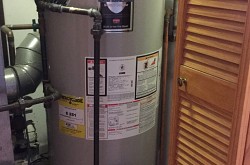
If you replace or add a boiler, furnace, heat pump or air conditioner, ask the contractor if the product qualifies for federal HVAC tax credits. It must meet specific requirements for efficiency ratios, performance factors and fuel utilization efficiency.
You may also qualify for an HVAC tax credit for a new circulating fan in your furnace, but there are additional requirements. Fans that use more than 2 percent of the furnace’s total energy do not qualify for federal HVAC tax credits. Also, if the furnace does not qualify for the HVAC tax credit, you can only apply for 30 percent of the cost of the fan, not the entire furnace replacement.
Additional Savings
In addition to the federal HVAC tax credits, the Department of Energy expects to provide federal rebates for the purchase of energy-saving Energy Star appliances in 2010. At least 36 states already have Energy Star rebate programs, and the federal Department of Energy expects to approve similar programs in the remaining states and six US territories by the end of 2009. Click here for links and more information.
Of course, energy-efficient appliances are designed to save you money, and you may recoup the cost in several years through lower electric bills, with or without tax rebates and credits.
Author Steve Graham is an expert on green building who writes for several home improvement publications. He's full of great, practical home improvement answers, and incidentally, he's pretty funny — so send him a message.